Aberdeen transformed: energy legacy to diversified logistics hub
Aberdeen remains synonymous with North Sea oil and gas logistics. The North East Scotland city has been for decades. As the fossil fuel energy sector matures and declines, Port of Aberdeen is undergoing one of the most significant transformations in its 890-year history.


A port built on energy
Few UK ports are as closely identified with a single industry as Aberdeen has been with offshore oil and gas. Over the past half-century, it has functioned as the principal logistics base for North Sea exploration, production support and offshore supply operations.
That legacy, according to chief executive Bob Sanguinetti, is both an asset and a constraint. “It was a very bold and ambitious decision taken by our predecessors,” he said, referring to the South Harbour investment. “Initially, it was in the oil and gas space, but it soon became apparent that, as oil and gas will naturally come to an end at some point, we needed to think about long-term strategy and how to keep the port relevant.”
Aberdeen’s offshore ecosystem has developed around supply vessels, subsea engineering, drilling logistics and personnel transfer operations. This has created a dense industrial base of marine contractors and energy service companies embedded across both North and South Harbours.
Sanguinetti is clear that hydrocarbons will remain part of the mix for years to come. “Oil and gas remains our most significant sector, and we are going to need it for decades to come. We are fully focused on supporting customers, consolidating our position, and building on our good progress with attracting jack-up rigs and other associated vessels.”
The transformational South Harbour
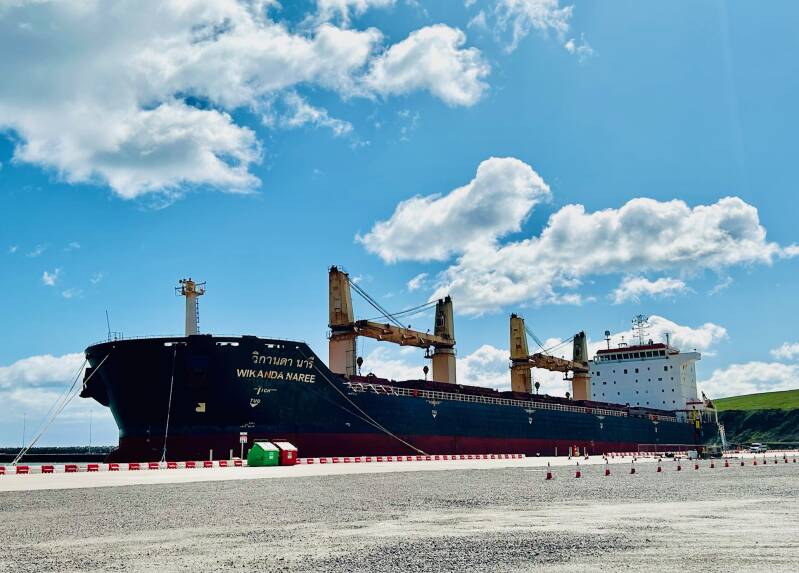
The centrepiece of Aberdeen’s modernisation is the £420 million South Harbour development at Nigg Bay, completed in 2023. The scheme added around 1.5 km of deepwater quay and significantly expanded laydown and heavy-lift capacity across the port.
In total, Aberdeen now offers nearly eight kilometres of quay across its combined harbour estate, making it by some reputes among the largest ports in the UK by berth length.
Sanguinetti described the project as transformational in both scale and capability. “It has increased our quayside length by about 20 per cent, but crucially it has given us much deeper water,” he said. “All of South Harbour is at least 50 per cent deeper than the deepest bit of North Harbour. So it has taken us into a new domain completely.”
With South Harbour, the expanding port now provides water depths of up to 10.5 metres LAT, heavy-lift capacity of around 140 tonnes per square metre, and extensive laydown space approaching 692,000 square metres. It is designed to accommodate vessels up to 300 metres in length and support offshore energy, project cargo and bulk operations.
The facility is already reshaping operational patterns. Offshore wind components, subsea structures and integrated project cargoes are increasingly consolidated and assembled at South Harbour before offshore deployment.
However, optimisation is still evolving. “We are about 90 per cent floating offshore wind project ready,” Sanguinetti said. “Dredging some of South Harbour by an extra two to three metres will put us absolutely where we need to be.”
A dredging programme is now under consideration, alongside potential investment in additional heavy-lift infrastructure, including large mobile harbour cranes.



Offshore energy transition
Offshore wind underpins Aberdeen’s long-term repositioning as a broader energy hub. The North Sea is expected to host substantial floating and fixed-bottom wind deployment over the coming decades, and Aberdeen is seeking to establish itself as a staging, assembly and maintenance hub.
Sanguinetti set out the ambition in clear terms: “We want to be doing exactly the same for offshore wind for the next 60 years plus as we have done for oil and gas.”
Rather than manufacturing turbine components, the port’s role is expected to focus on integration and mobilisation. “We are not in the market for very large-scale heavy manufacturing,” he said. “Where we are well placed is integrating component parts, putting them together and towing them out to deployment sites.”
Geography is central to that proposition. Aberdeen sits close to major planned wind farm zones off Scotland’s east coast, reducing tow-out distances for assembled structures.
The port also anticipates a growing role in offshore wind maintenance and component replacement. Sanguinetti highlighted current inefficiencies in the system, noting that damaged turbine components have previously been transported as far as Rotterdam for repair. Aberdeen intends to capture a greater share of that activity in future.
Managing a complex harbour
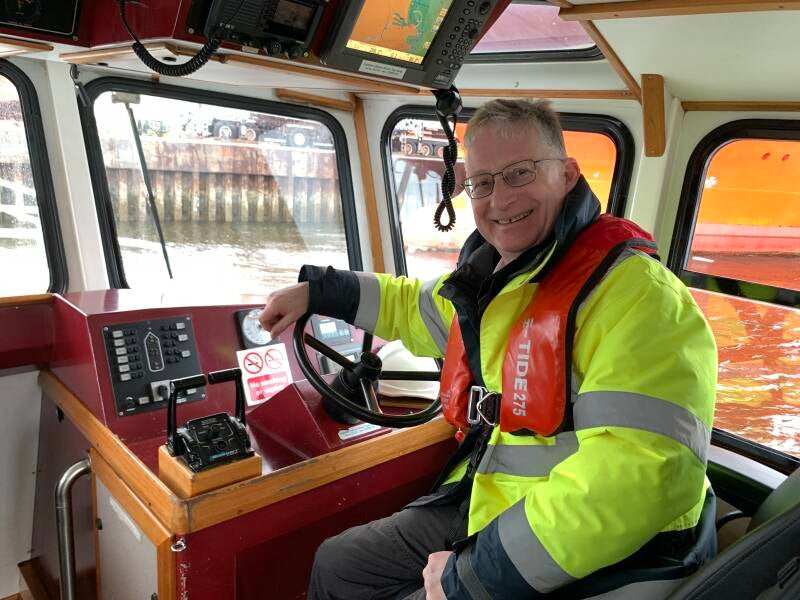
Operational complexity is increasing as cargo diversity expands. The Marine Operations Centre coordinates vessel traffic across both North and South Harbours, managing one of the busiest port systems in Scotland.
Aberdeen accounts for approximately 40 per cent of all ship movements through Scottish ports, requiring continuous coordination between offshore supply vessels, ferries, cargo ships and specialist energy assets.
Sanguinetti highlighted the role of digitalisation in managing this complexity. “We have rolled out a 5G programme, so we now have the backbone infrastructure to facilitate data handling and management,” he said. “We are in a much better place to monitor environmental conditions across both harbours.”
Work is also underway on digital twin technology to model South Harbour operations, particularly in relation to offshore wind logistics and berth optimisation. The objective is to improve vessel flow while maintaining operational continuity across multiple cargo streams.
Cargo diversification
While offshore energy remains dominant, Aberdeen is actively broadening its cargo base. Commercial director Roddy James said the port is already seeing early diversification into new sectors. “We are going to see growth in ro-ro capabilities, bulk exports, heavy lift out-of-gauge items and hopefully container shipments,” he said. “Containerised cargo would be a first for the north of Scotland.”
He added that offshore wind, decommissioning and bulk commodities will all play a greater role in future traffic. “We know decommissioning will start to pick up, and renewable sectors are coming online. That is where we see opportunity for growth.”
Timber exports are also emerging as a notable flow, with recent shipments to Scandinavia. There is a circular logistics dimension to this trade, with raw material potentially returning to the UK as finished goods for retail distribution.
At the same time, legacy infrastructure is being repurposed. The former Aberdeen fishmarket at Palmerston Quay has been redeveloped by Streamline Shipping Group into a freight and distribution terminal serving Scotland and the Northern Isles.
Rail freight and multimodal
Rail remains a secondary but strategically discussed element of Aberdeen’s logistics ecosystem. Waterloo Terminal, Craiginches Yard and Raith’s Farm near Dyce form the core of existing rail infrastructure, although each presents operational constraints.
Waterloo is considered unsuitable for modern intermodal use due to layout and handling limitations. Craiginches offers more potential, including legislative provision for future connectivity to South Harbour, although physical distance and topography remain challenges.
Raith’s Farm, completed in 2009, remains largely underutilised despite being a modern intermodal facility. It was intended to replace the former Guild Street yard but has seen limited regular use, reflecting the dominance of road-based logistics in the region.
Both Sanguinetti and key account manager Chris Whetham acknowledged long-term potential for rail freight growth, particularly linked to offshore wind, decommissioning and bulk cargo flows. However, viability will depend on achieving sufficient cargo density and commercial alignment with operators.


Future port
Aberdeen’s long-term strategy is framed explicitly as evolution rather than replacement. The objective is to maintain its position as a core offshore energy hub while expanding into adjacent logistics sectors.
Sanguinetti described the transition as a generational shift. “We want to be the key logistics hub for offshore energy, but there will be a more equal balance between fossil fuels and offshore wind, and we will be a much more diverse port making full use of South Harbour,” he said.
Decarbonisation is central to this evolution. The port is targeting net zero operations by 2040, supported by the UK’s largest operational shore power system, electrified equipment, renewable electricity procurement and LED infrastructure upgrades. South Harbour has been designed with future energy systems in mind, including service trenches capable of accommodating future low and zero-carbon fuels or electrical distribution infrastructure.
“We have done the groundwork so that we can enable future energy systems at reduced cost when the time is right,” Sanguinetti said.
While the transition is complex and capital-intensive, the strategic direction is clear: Aberdeen intends to remain a critical logistics node for North Sea energy, regardless of sector composition.
As Sanguinetti put it, the port’s defining characteristic is continuity through change. “We are still the busiest port in Scotland, and we have been adapting for nearly 900 years. That is not going to change.”
Add comment
Comments